

@gmagalios


Generosity of Spirit
in Contemplations, Featured Articles, Philanthropy
by
George Magalios
The purest form of generosity is to give without concern for a return on the gift. In such a phenomenon generosity is its own reward. Within the power dynamic of philanthropy, from the simplest act of giving to the gargantuan financial awards bestowed to museums by their wealthy benefactors, generosity is in its own way, a benevolent act, whether or not there is a transactional nature to the exchange of giving.
To be sure, philanthropic endeavors by the super wealthy are often critiqued as “easy giving” or simple “tax-liability write-offs.” While these insights are by no means invalid, the larger scope of the philanthropic dynamic is often lost amidst such perspectives. The beneficiaries of such gifts, be they individuals or cultural institutions and charities, benefit regardless of the intent of the giver. What we are concerned with in questioning generosity of spirit is the phenomenon that drives the intent to give.
Generosity of spirit is the dynamic of philanthropy that transcends financial and material considerations to encompass the psychological, emotional and philosophical components of the phenomenon we call giving.
Whether a person benefits from her act of charity means nothing to the beneficiary of such act. It is a uniquely human phenomenon to find fault with those who give, particularly by others who are unlikely to be philanthropists or donors of any kind. Such a failure of the moral imagination begs many questions better left unattended in this exploration of generosity of spirit.
The term “spirit” has many meanings, many connotations and many histories. Thinkers from Hegel and Heidegger to Jesus and Plato have voyaged through the dense jungle of meanings such a term conjures, each with a uniquely enlightened path worthy of review, study and memory.
For our purposes, spirit may be employed as a way of thinking about belief, intention, attitude and origin. When generosity comes from an innocent and thoughtful place of purity then one can say such a generosity is of an enlightened spirit, one worthy of emulation, study, and homage. In short, what is gained most from generosity of spirit is honor. The Greeks call the love of honor “Philotemi.” Honor is here understood as a way of thinking and being that glorifies word and deed in the eyes of a community or individual.
In this way honor is intimately tied to the concept of dignity. Both ideas are essentially value systems shared between individuals and communities that center on the concept of worth. Worth can be defined and measured in many ways. In today’s world, most people measure worth through money. When it comes to the worth of actions, of behavior and generosity of spirit in particular, worth cannot be measured in dollars, it can only be measured in esteem, respect, love and affection. Such phenomena are shared emotions and yet go beyond the emotional to encompass a foundation upon which people interact and pay their love and respect to each other. Dignity and honor are the highest forms of valuation when it comes to love, be it for a stranger, friend or intimate companion.
Generosity of spirit is the expression of love for others, usually those less fortunate in a material sense, while honoring our shared humanity. This is the ultimate form of wealth in human capital.

Review: Monumental Journey, the Daguerrotypes of Girault de Prangey at the Metropolitan Museum of Art
in Art, Featured Articles, Reviews
Both a journey back in time and an exquisite taste of antiquarian photography’s delights, the daguerrotypes of Joseph-Philibert Girault de Prangey (French, 1804–1892) represent a monumental artistic achievement that contributes as much to the history of art as it does to a knowledge of ancient architecture. Mr. de Prangey was more than just a photographer. Born to an aristocractic French Family in Langres, he eventually eschewed the career path laid out for him by his father and began to study, drawing, painting, architecture and photography on his own.

The Temple of Olympian Zeus in Athens, de Prangey, 1842, Qatar Museum Collections
An eccentric and an autodidact, he eventually decided to do what 19th century French nobility does: visit the ancient locales of Athens, Damascus, Cairo, Rome and Florence. During these travels he brought along his box daguerrotype cameras, apparatuses that were either customized for him or built by him. Art historians know this because of the unusual sizes and proportions of his finished works. He would often expose 2 or 4 images on one glass plate and later cut the plates to get multiple smaller finished photographs. Since the plates and box cameras were bulky and heavy, particularly for 19th century travel, Mr. de Prangey had to economize his method and his range of tools to capture the memories and visual treasures of his travels.
The daguerrotypes of de Prangey are the earliest known photographs of Greece Palestine, Egypt, Turkey and Syria, taken during a three year excursion that began in 1842. Incredibly, his works were thought to be lost to history’s oblivion since the artist had no heirs or close family upon his death. But as fate and art history fortunately decreed, his daguerrotypes were saved when they were found in the 1920s and presented for sale to the Bibliotheque National de France, who promptly refused to buy most of them. Fortunately other collectors and institutions saw both the historical and artistic value of these exquisite images and they were eventually collected and kept safe, stocked away in private collections until recent art historians and collectors began to prize them for obvious reasons. It is estimated that there are approximately 1000 de Prangey daguerrotypes extant and that at one time the total number of works was well in excess of 2000.

de Prangey, daguerrotype, view of Jerusalem
The Metropolitan Museum of Art’s exhibition on de Prangey, Monumental Journey, features over 50 works in a very dimly lit gallery that includes an extensive amount of historical background. This historical context of the uniquely gifted Frenchman is especially crucial to an understanding of the gorgeous and mysterious works on view. The show includes engravings, drawings and paintings, many of which were made by de Prangey himself.
To experience these unique works is to explore the phenomenon of time and perspective. That the Met’s exhibition is an exquisite history lesson on its own is without dispute. When you consider the grandeur and mystery behind these images the shadow of geopolitics is never too far away. Considering the relative innocence and naivete with which a European gentleman captured the historic structures and cities of the Mediterranean and North Africa we are never far away from a meditation on European colonialism.

A Slide Box containing daguerrotypes owned by Girault de Prangey
Perhaps one can view Mr. de Prangey as the benevolent documenter of time, of world history, of architectural and art history whereas such perspectives of later European forays into these lands would be harbingers of violence, economic and political exploitation the likes of which Africa has still not recovered from.
It would be morally irresponsible to regard and study Mr. de Prangey’s pictures of the Dome of the Rock or the Roman Forum without at least a reflection on the temporal moment and the historical states of Mr. de Prangey’s travels and what they represent in European, indeed, world history.

Girault de Prangey, Promenade et tours d’enceinte du palais de l’Alhambra à Grenade (Towers surrounding the Alhambra Palace, Granada)1883, oil on canvas, Musée d’Art et d’Histoire, Langres
When I viewed this show I recall the solemnity and gravity with which my fellow viewers brought with them in front of each carefully illuminated image. It is impossible to view the daguerrotype of the Parthenon and not be stricken with awe at the magnificence and historical tragedy of the structure and everything the daguerrotype represents, particularly when one recalls that de Prangey took the daguerrotypes while Greece was still just recovering from nearly four hundred years of an Ottoman occupation of its territory. Even more poignant is the fact that many of the sites photographed by the vagabond artist no longer exist.

de Prangey, double self-portrait
What is most intriguing about Mr. de Prangey’s life is not simply the astounding breadth and refinement of his daguerrotypes, paintings, and drawings, it is the unconscionable phenomenon that his work was largely ignored, if not downright neglected by the aesthetic and academic powers of his day. Thankfully, history has finally paid its respects and honored this brilliant French polymath and artist. Lovers of photography, architecture and history all owe the Metropolitan Museum of Art in New York, curator Stephen C. Pinson, Curator in the Department of Photographs, and organizers of this beguiling exhibition an un payable debt of artistic and intellectual gratitude.

Review: The Marriage of Figaro by the Florida Grand Opera in Miami
That The Marriage of Figaro is an opera with an illustrious history is without question. Among the most popular and beloved operas, Wolfgang Amadeus Mozart’s ribald story is known as an “opera buffa” or “comic opera.” The recent production by the Florida Grand Opera, part of its 2018-2019 season, is an excellent adaptation of a work whose complexity often belies its somewhat farcical nature.
First performed in 1786 at the Burgtheater in Vienna and with a libretto by Lorenzo Da Ponte, The Marriage of Figaro was directed in its Arsht Center production by Elise Sandell, though the initial production originates at the Michigan Opera Theatre. Performed lovingly in Italian with supertitles in both English and Spanish, the four act, three-hour long extravaganza provides viewers with many opportunities for chuckles, chortles, smirks, guffaws and smiles.

The Marriage of Figaro, Performance View, Florida Grand Opera, 2019
The Florida Grand Opera has created a genuinely intimate and exquisitely refined production of this classic that features many unique inflections in the musical cannon of the great Mozart. Based on a stage comedy by Pierre Beaumarchais, Mozart created a wondrous flow of lyrical levity and vocal fortitude that command attention while allowing you the occasional reverie into true love’s possibilities.
What made the night was a scintillating performance by Lyubov Petrova as Countess Almaviva. Her delicate grace and subdued sonic force radiated throughout the sonorous halls of Miami’s grandest theater. Jonathan Michie’s Count Almaviva was a poignant counterpoint to Petrova’s Countess and made for a refreshingly balanced verve in the evening’s proceedings.
Figaro, played with the right blend of comic wit and dramatic tension by Calvin Griffin, was also a standout. Elena Galvan’s Susanna was a highlight, particularly her loving movements and vocal incantations that added a degree of heft and weight to an otherwise lighthearted storyline.

The Marriage of Figaro, Performance View, Florida Grand Opera, 2019
With a set designed by Susan Benson and a strong orchestra ensemble conducted by Andrew Bisantz, the experience of seeing The Marriage of Figaro again was made whole and memorable, ably and zestfully rendered by an experienced and powerful opera company. The Florida Grand Opera is one of the nation’s treasures and a special cultural powerhouse in the South Florida high art scene. With a seemingly constant emphasis on the new, novel and fresh for their own sake, great traditions are often left behind, forgotten or undervalued. This is not the case with the opera in Miami, Fort Lauderdale, and West Palm Beach, where the Florida Grand Opera produces its masterworks, including The Marriage of Figaro.

Creativity as Philanthropy
October 23, 2018 in Contemplations
by
George Magalios
One cannot speak of creativity, or art, without a parallel discussion on capital and its exchange. All art today is a tangible product destined for some sort of transactional exchange. In the not too-distant past, artworks were products of religious rituals whose function could not be separated from piety and devotion, from communal religiosity and the sacred.
Today’s paintings, sculptures, photographs, and works on paper have become commodities and symbols of status, traded like stocks among the very rich and hoarded in a buying frenzy that amounts to a very complex and sophisticated form of money laundering. Limiting the discussion on creativity to works of art means limiting the contemplation of creative output to a socio-economic critique. When we expand art to mean “creativity” then we can begin the discussion on giving and philanthropy.
Art is not, by definition, often understood as a gift, though it is a form of giving. The distinction between giving and receiving, and giving with nothing being acquired in return, is what defines the very nature of philanthropy. As it applies to works of art, they become works of philanthropy in both the individual and social context when one acknowledges the gift of knowledge and discovery involved in the interplay between a work’s resonance and the artist’s production and the viewer’s contemplation.
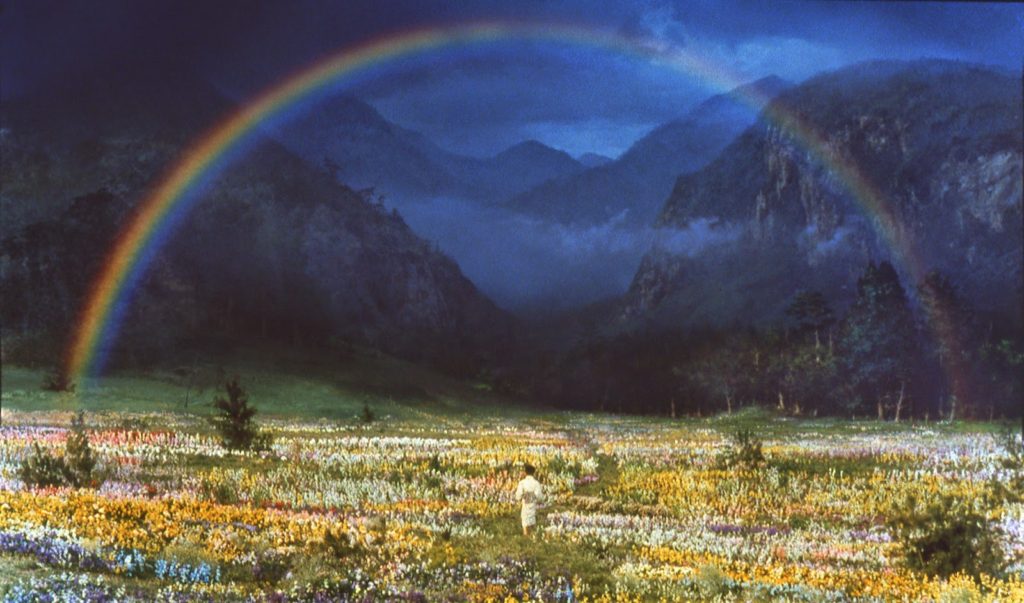
Still from Dreams by Akira Kurosawa, 1990
How does art lead to philanthropy?
Philanthropy (Greek for “the love of people”) is often associated with galas and charities, reserved for the purview of the very wealthy and those for whom it is part of a social and economic status signifier. But the true meaning of philanthropy is rooted in the “philos,” or love of giving, one that asks nothing in return for the act of generosity. Acts of philanthropy can be as humble as being kind to a stranger on the street, giving free advice to a friend to offer perspective on an ethical dilemma, helping someone with small tasks, and many others.
By dedicating The Sophia News to creativity and philanthropy, we are attempting to rescue the love of humanity from the often monopolistic relationship the economic elites of the world retain, while simultaneously honoring great artists and creators, whether they are in the contemporary art world, or self-made cathedral builders such as Justo Gallego.
The nature of creation is a gift. When an artist makes a painting, it may be a sublime act of giving and the result of a dialogue between the natural world, the social world and the artist themself, even when the dictates of the art world and the relationship between artworks and capital predetermine the artist’s work as labor with the goal of producing a valuable commodity. The gift arises when that artwork is viewed by those who do not own the work and acquire from this moment a gift of grace, understanding, wisdom or enchantment. This happens most often in museums– sacred storehouses of world culture whose works are most often acquired through acts of philanthropy on behalf of collectors. In short, the philanthropic dynamic that takes place between artists, cultural institution, and collector is the gift of the bestowal of beauty, truth, and wisdom that grounds all artworks at their most poetic.
This gift is most powerful when shared by a larger public. But it is no less profound if one sole observer encounters a work that leads to giving, contemplation and enlightenment.
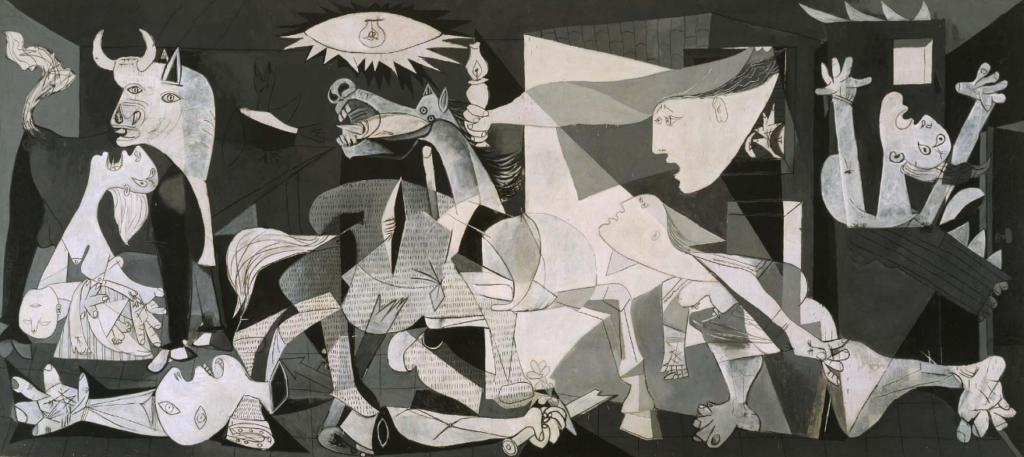
Pablo Picasso, Guernica, 1937, oil on canvas, courtesy of the Reina Sofia Museum, Madrid
When a work of art is deemed worthy of a museum, it becomes an object of remembrance.
Is the same true for the act of creating when the work in question is not art, but rather food, an item of clothing, or a word spoken?
When a baker makes bread, the act of creation is a form of giving as nourishment, unique to its moment. In its essence, the baker’s work is equal to– and in some cases, greater than– any work undertaken by the painter. What distinguishes the baker’s act of creativity from the artist’s is both the longevity of the work made and the nature of societal positioning of the thing produced. The bread is a temporal food while the work of art is meant to be permanent and trans-historical. The function of a painting differs greatly from that of a loaf of bread. The bread that feeds a child is no less great in form or poetry than a portrait by Rembrandt, but its social resonance is indeed limited in scope and pales in comparison to the intellectual and emotional impact the work of art will have on others.
To make art is to be courageous. It is to assert one’s will against the momentum of mediocrity and banality of daily life and against the oblivion of time.
To craft a work of art is, in its own unique way, an act of philanthropy in that it becomes a gift to a social world that may or may not be beautiful, that may or may not reveal a higher truth, that may or may not speak for a specific moment of history.
Nonetheless, a child’s drawing or a master’s portrait is the same act of giving in its creative essence.
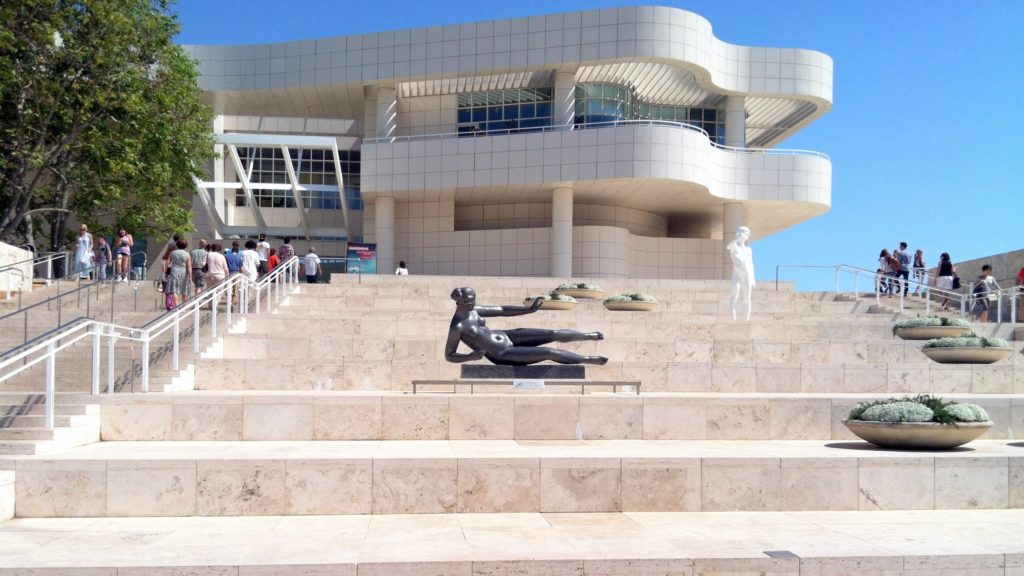
Getty Museum, Los Angeles
When a mother bakes a cake, it is a creative act of giving to her family. When J. Paul Getty bequeathed $700 million to his trust and entrusted his collection of art to a new museum in his name, it is no more or no less an act of philanthropy than the mother’s cake, in its essence.
What distinguishes these two acts of giving is their social and historical relevance. Mr. Getty’s act of bestowal becomes a philanthropic act of majesty only because he was first able to master the art of acquiring the capital necessary to amass a collection of great works of art, design and other objects. Towards the end of his life, Mr. Getty, like Andrew Carnegie, Paul Mellon and many other magnates before them, subsumed the pleasure of acquisition for the grace of bestowal, thinking ahead to his legacy as philanthropist and giver.
This intricate and mysterious relationship between acquisition and giving speaks to the essence of the artist-viewer relationship. It is the fundamental dynamic that imbues “Sophia,” Greek for “Wisdom,” as an enticing and seductive endeavor whose reward is understanding, grace, and enchantment.
Art becomes a practice of philosophy (the love of wisdom) when its works contribute to the spiritual, intellectual and aesthetic wellness of a person or society. What takes place in the revelation, in the unfolding of beauty, truth, knowledge and history contained within a great work of art is the very definition of aesthetics. In this way philanthropy is generosity returned. It is the viewer’s counter-giving sparked by the artist’s endeavor.


